Your Biggest Asset Isn’t on the Balance Sheet.
What the rise of the intangible economy means for private companies
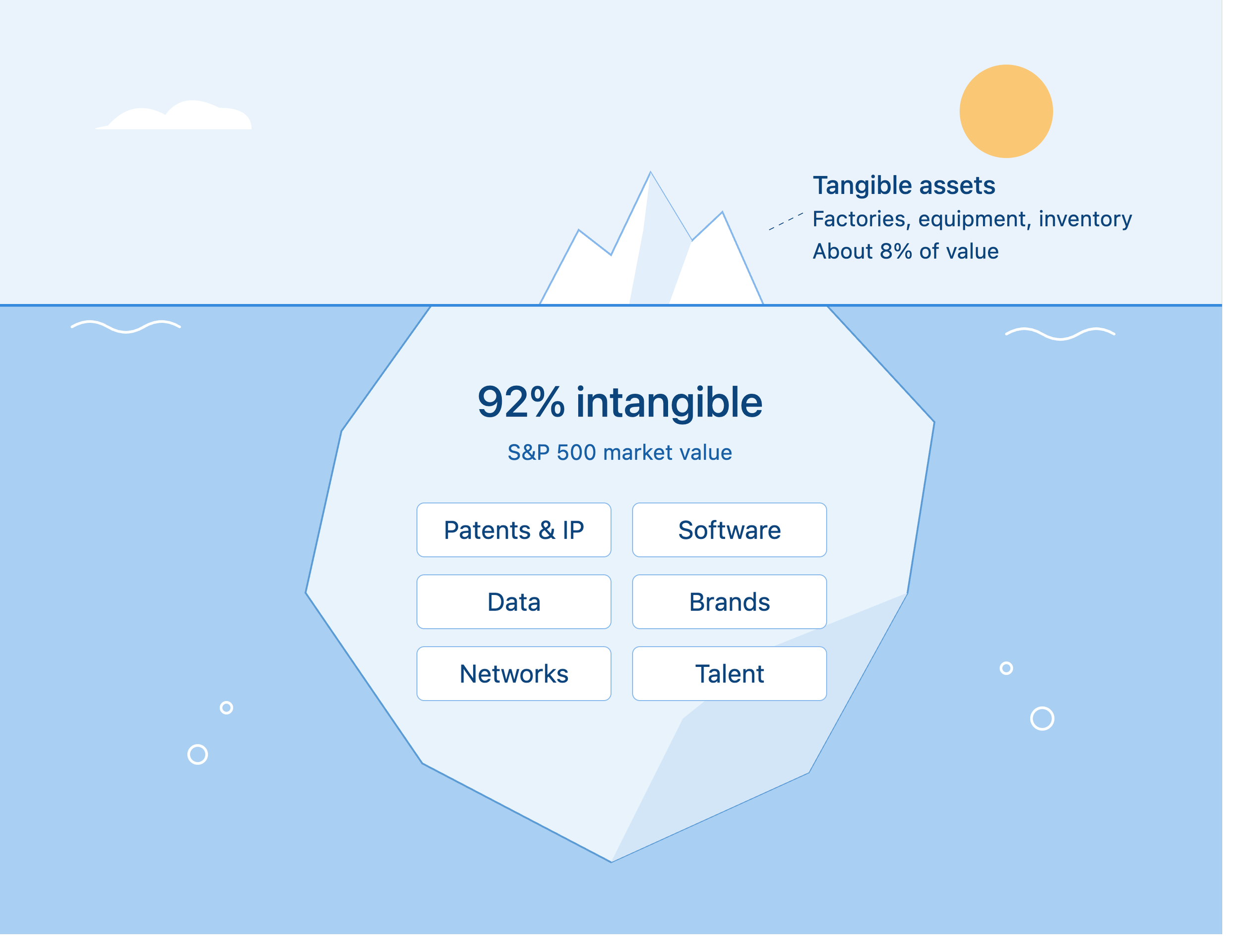
Fifty years ago, a company's value sat largely in things you could touch: factories, equipment, inventory. That is no longer true. According to Ocean Tomo's Intangible Asset Market Value (IAMV) Study, intangible assets now account for approximately 92% of the total market capitalization of the S&P 500. Those assets? Intellectual property, software, data, brands, networks, and talent.
The scale is striking. To underscore this, a recent Financial Times analysis by Tej Parikh* draws on World Intellectual Property Organization data showing that U.S. investment in intangibles reached roughly $4.7 trillion last year, nearly twice the combined total of France, Germany, the UK, and Japan.
Importantly, the article notes that intangibles behave differently from physical assets: they cost a lot to create but almost nothing to replicate, which creates scalability and synergy effects, and tends to concentrate value in a small number of winners.
Parikh examines this incredible concentration as well as a few other key factors to explain the nature of the intangible economy (and the intangibles-dominant S&P 500’s exceptionalism), which we also argue has implications for private companies that have large intangibles composition.
The true economics
There are two primary dynamics at play that explain intangibles’ hidden value:
Under standard accounting, most intangibles a company builds itself are treated as an expense rather than recorded as an asset, unless they are acquired. So, the balance sheet can severely understate what a business really owns. The analysis cites one investor's estimate that crediting intangibles properly would cut the apparent overvaluation of U.S. stocks over the last couple years by roughly a quarter to a half.
That is a public-market problem, where at least there is a share price to anchor on. For a private company, the gap is wider. There is no market quote for patent portfolio assets, brand equity or human capital contribution, and the balance sheet says very little about it.
As the article notes, “Intangibles often derive most of their current value from potential future cash flows.” This is particularly problematic for our usual way of valuing assets or businesses, as it presents uncertainty. But uncertainty can be overcome with adept due diligence, benchmarking and scenario/sensitivity analysis, turning intangibles’ inherent opacity into intelligent signals.
Not a legal question, but a commercial one
The article makes a point that anyone in our field will recognize: a patent could be "worthless or worth billions," depending on market adoption, competition, and regulation.
Look closely at these three drivers. None of them is a legal question. The patent's claims tell you what is protected. They do not tell you whether anyone will pay for it, whether a competitor can design around it, or whether the market will adopt the technology at all. These are commercial questions, and they decide the value.
This is why intangibles need to be valued using a commercial lens, starting with the market opportunity and the product strategy (then applying the patent/legal lens). A strong portfolio attached to a weak market is just an intricate document describing complex technology.
Evaluating (and valuing) the market opportunity, importantly, does not mean just applying a TAM (total addressable market) or even SAM (serviceable addressable market). The opportunity is derived from the ability of the IP to drive incremental income for the firm, above and beyond what the tangible assets provide. Understanding this nuance and identifying the unique characteristics of the intangibles, the nature of how they help differentiate, is the key to determining a discrete and defensible value to ascribe to each.
The proof for private companies
PitchBook’s February 2023 report, Introducing PitchBook Patent Research, provides evidence of the relationship between intellectual property and company value. Its analysis of US-headquartered venture-backed companies (from 2011-2020) found that startups with granted patents or pending patent applications consistently attracted larger investments and higher valuations than those without:
Deal flow: 63% (late-stage) and 80% (venture-growth) of capital went to patent companies
Deal sizes: funding rounds were 40%–60% larger
Valuations: the average premium in annual median valuations was approximately 93% for angel-stage companies and 51% for late-stage companies.
Exits: acquisition value was 155% higher
Exit nature: 23.2% of patent-seeking businesses exited through public markets, compared with just 4% of those without patent activity
While this is not casual necessarily, the correlation at least points to the signaling effect: firms that have strong technology and have taken steps to document and protect it are more successful in demonstrating the differentiation and incremental value to employees, customers, investors and acquirers.
The implications for private companies
Raising Capital: Investors want to know what the IP is worth and how defensible it is, beyond the claim that you hold patents. Document your trade secrets appropriately, conduct a strategic exercise to determine what IP requires trademarks and patents, and bring in strategy and valuation experts to build a cohesive and defensible story.
Borrowing: Lenders need a floor they can underwrite, which means a conservative, well-reasoned scenario rather than a best case. The more substantiation related to the assets that are less obvious, the more confidence the lender will have in the business model, especially those in the early stage with less established revenue.
Selling: Acquirers price strategic value. Showing a buyer what the IP is worth to them can change the conversation about the multiple. Furthermore, the value of the intangibles, as previously noted, will scale at a greater rate for strategic buyers who can leverage the assets across broader markets and geographies.
In each case, a documented strategy and valuation with credible due diligence that ties to a clear market need signals a business with latent superpowers.
The bottom line
The intangible economy has made IP central to how companies should be valued, but the underlying mechanisms for measuring it have not kept pace. For companies built on proprietary technology and human intellect, that gap is an opportunity: the ones that can show what their intangibles are worth, credibly, will have an edge in every capital conversation.
If you are preparing a raise, a debt facility, or an exit, please contact us.
*Source: Tej Parikh, "The rise of America's intangible economy," Financial Times, August 10, 2025.